If you have read our post on Bangkok accommodation, you know by now that we love the local vibe that Bangkok has got to offer. On the other hand, it’s fair to ackowledge that in 2025, Bangkok was ranked the world’s most visited city by international arrivals, welcoming around 30.3 million visitors. If you are looking at visiting Bangkok and still see the main sights while avoiding tourist traps, this independent 3-day Bangkok itinerary is just for you. And if you are planning a beach vacation after Bangkok, check out our post on the beautiful island of Ko Samet, a quieter alternative to Krabi or Phuket.
Tourist traps to avoid
If you would like a more local vibe, do not book with a travel agent; plan your own activities instead. These are some of the places we think you should avoid or spend very little time while in Bangkok: Khao San Road, Tour run floating markets such as Damnoen Saduak, Patpong night market and Silom Road (unless you’re after adult entertainment), Maeklong Railway Market, Rama 9/Jodd Fair night market (unless you want to see Tiktokers eating raw squid for a dare in front of many cameras), Sky bar at Lebua (if you are on a budget and don’t want to spend $30-$40 on a cocktail there are other rooftop bars that are nice and cheaper).
3-day itinerary
🛕 Day 1 – Temples, river life, Wang Lang & sunset cocktails

- Grand Palace / Wat Pho
- Nearest MRT: Sanam Chai (MRT Blue Line). If you are into history, a visit and tour of the Grand Palace is definitely something you will enjoy. If you are not, you can always see this area on foot and admire the Grand Palace from the outside on the way to Wat Pho. Whatever your choice, make sure to start your day early as the heat can be overbearing when visiting temples. Be aware that this is a very touristy area so it will be quite busy, the early you start your visit, the better.
From Wat Pho, walk to Tha Tien Pier and take the public ferry across the river to Wat Arun. This is a straight walk from the temples to the Pier, about 3-4 minutes. The Piers are all clearly marked. Once you are there, tell the ticket lady where you are going (Wat Arun), the ticket is literally pennies. Ferry crossing takes only a few minutes and runs continuously.
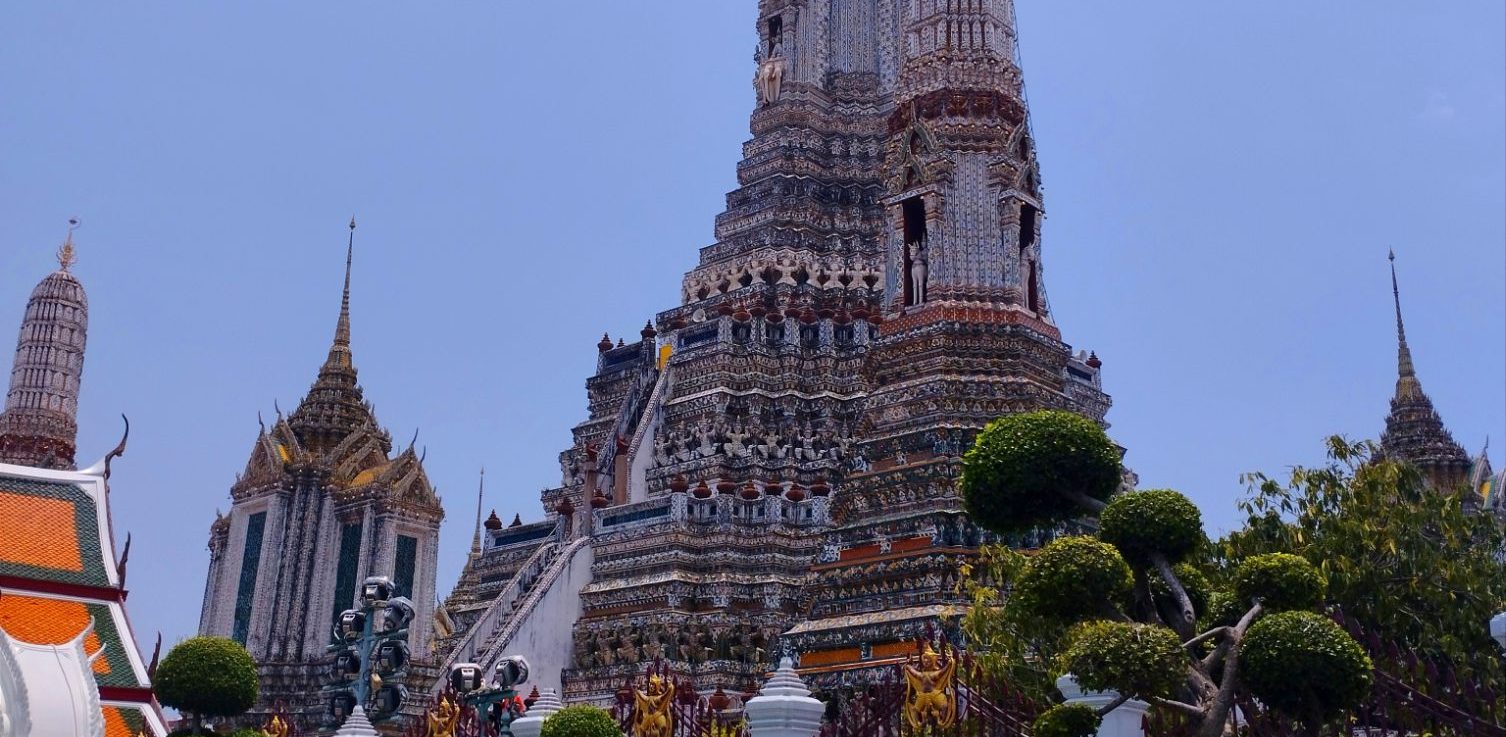
- Wat Arun – this is in our opinion the most impressive temple in Bangkok if you like arts, ceramics and colours. I also love the gardens just outside. It won’t take long to visit this temple but it is truly worth it. Make sure that you accept the free water at the entrance or buy some as it can get very hot especially if you climb the stairs which we recommend if you are fit enough.
After visiting Wat Arun, head to Wang Lang Market, this is an authentic thai market where university students and medical students have lunch (the students in their nurses outfits are so sweet):
- Option 1 (recommended): Ferry
- Walk to Wat Arun Pier → ferry to Wang Lang Pier
- Option 2: Walk
- Walk north behind the temple for about 20-30 minutes if you feel like exploring backstreets and canal life.
Spend the early afternoon at Wang Lang Market — casual late lunch, sweets, and wandering among student-focused stalls.
Return to your hotel mid-afternoon to rest and change.
For sunset cocktails (it is really important to get there before sunset for a truly magical experience so aim to arrive at 6pm and book beforehand):
- Octave Rooftop Bar
- BTS: Thong Lo
- Good alternatives with views and calmer energy:
- Above Eleven – BTS Nana
- SEEN Rooftop (Avani Riverside) – BTS Pho Nimit + short taxi
For dinner option please go to the Where to eat in Bangkok section.
🚤 Day 2 – River ferries, ICONSIAM, Talat Noi & Chinatown

Morning:
- Take the BTS to Saphan Taksin (Silom Line)
- Walk to Sathorn Pier (Central Pier) – very short walk and follow the signs (Exit 2)
Once you arrive at the ferry, follow the sign to ICONSIAM or ask the ticket operators, they all speak English. The ferry to ICONSIAM used to be free but it is now 8 Baht, which is $0.20. Take the public ferry to ICONSIAM.
At ICONSIAM:
- Enjoy river terrace views, you can access the terrace via the Apple store on 2nd Floor
- Coffee at % Arabica, this is a very nice coffee a must try in Asia
- Browse the food court and small floating-market-style section
- Light shopping
- Early lunch to avoid crowds. The food court is cheap and has really nice food and atmosphere.
After lunch:
- Take the ferry again and get off at Marine Department Pier. There is usually 2 options, the Chao Praya Express Boat (blue flag) which is 40 Baht per ride (less than $2) or the Orange/Yellow Flag which is half the price usually about 20 baht but with less availability. Once you exit Iconsiam, just walk towards the pier and ask the ticket operator for times. This is your opportunity to enjoy the river, take pictures and explore this beautiful part of the city, you will go past Wat Arun again on your way to Chinatown.
From Marine Department Pier:
- Walk into Talat Noi for murals, old shophouses, and narrow lanes. This is a very cute part of Bangkok with very cool murals.
- Continue walking into Chinatown (Yaowarat)
Explore:
- Chinese temples
- Gold shops and herbal medicine stores along Yaowarat Road
- Side streets for everyday shopping and snacks such as Sampeng Lane, Song Wat Road, Chareon Krung Road, Plaeng Nam Road, and Phat Sai Road.
Stay until sundown to see the neon lights and street food stalls come alive. Chinatown is very interesting and it is your chance to see (or try if you are brave or silly) bugs and scorpions and seafood on sale from the street vendors. It is really cool to explore but we wouldn’t recommend to eat on the main street.
Off-the-beaten-track dinner ideas in Chinatown:
- Nai Ek Roll Noodle – peppery soups, very local
- Heng Yod Phak – classic Chinese-Thai cooking, no frills

🛍️ Day 3 – Park, malls, massage & night market
Morning: Green space first
- Lumphini Park
- MRT: Lumphini or Silom
Lumphini Park is basically Bangkok’s big city park. It’s a nice, quiet spot to walk, relax by the lake, watch people exercising, and spot the water monitor lizards. They are so cool and big, and not dangerous but don’t try your luck and keep a safe distance.
- MRT: Lumphini or Silom
Lunch + shopping
- Head to Terminal 21 (Asok)
- BTS: Asok | MRT: Sukhumvit
- The terminal 21 food court is in our eyes unbeatable for choice and value for your money. Just go straight to the top Floor (San Francisco) and queue at the kiosk to get your prepaid card you use to pay at the stalls. Top it up with how much money you would like, but usuallt $3-4 dollars are plenty for lunch. If you think you want to try few dishes and get smoothies/ fruit teas/ desserts, you can top it up with $5-10 dollars and then at the end just go back to the kiosk and get back in cash whatever you haven’t spent. It can get busy and very overwhelming but there is a lot of choice and the food is really nice so it is definitely a must visit. Each stall has pictures of what they offer and everything is in English (staff also speaks English).
- After lunch, make sure you go down and explore every floor which has a different theme (Tokyo, Paris, London, Instabul and Rome).
- There is a newer and bigger Terminal 21 opened in late 2022 on Rama III Road, in the Bang Kho Laem area. It’s a larger mall with more space than Asok and designed with similar world‑city theming but on a bigger footprint. It’s a little outside the central BTS/MRT network; the easiest access is by BRT to Charoenrat station and then a short walk or shuttle, so it feels slightly more local and less crowded than Asok.
Afternoon: Choose 1–2 nearby mall areas (overload or not, it’s up to you)
Malls in Bangkok are very very cool, you might not want to visit them all in one afternoon or you can spread it around the few days, but make sure to visit at least one or two. Our favourite are Siam Paragon, Central World (love the Cath Kidston café there and you can have a Shake Shack Burger or visit the Cheesecake Factory for a sweet treat) and Em Sphere (with a cool but more expensive food court and Ikea). There are others very popular malls, infamous for knock-offs and tourist-targeted goods like MBK or Platinum Mall/Pratunam market, we did visit them and really dislike them, but if you are after knock-offs that’s where you want to go. If you want to shop like a local, have a look at our latest post on Bangkok shopping.
Option A: Siam area
- BTS: Siam
- Choose from:
- Siam Paragon
- CentralWorld
- Siam Center
(All walkable between each other)
Option B: Phrom Phong area
- BTS: Phrom Phong
- Choose from:
- Emporium
- EmQuartier
- Em Sphere
(More relaxed, upscale malls, these are all walkable between each other via the Sky Walk)
After malls:
- Thai massage
- Pool or rest at your hotel
If you are in Bangkok over the weekend, a visit to Chatuchak Market is a must. It is a very big market, full of all sorts of good, and most importantly very good priced souvenirs and bags/shoes/clothes, it has a couple of lovely bars/cafes with live music and also a food market, but we never like the look of it when we go so we have never tried it. The market itself is really good and what we like about it is that the sellers do not bother you and they are very kind and you can barter a little without fighting. It is busy but we never felt overwhelmed by it as other markets we visited in Southeast Asia.
Evening: Night market
- Rot Fai Night Market (Srinakarin)
- Best reached by taxi from your hotel
This market is still touristy but it still has a more authentic thai vibe and less busy than the central influencer-heavy markets. It has nice food at cheap prices and very cool vintage stalls and shops.
- Best reached by taxi from your hotel
🏯(Optional) Day 4 – Ayutthaya day trip
Ayutthaya is Thailand’s ancient capital, founded in 1350 and flourishing as a major trade and political center for over 400 years. Its ruins — crumbling temples, Buddha statues, and old city walls — are very beautiful and in our opinion a must visit.
Unlike heavily commercialized spots in Bangkok, Ayutthaya is not a tourist trap: there are no over-the-top shows, fake markets, or crowds of selfie-focused visitors. Most of the experience is simply walking or cycling among centuries-old ruins. The temples and statues aren’t recreated for tourists — what you see is authentic history preserved in place, which makes it a calm, meaningful, and genuinely immersive visit.
Morning departure:
- Leave Bangkok early, around 7:00–7:30 am, to make the most of the day and avoid midday heat.
- Option 1 – Train:
- Take the train from Hua Lamphong Station to Ayutthaya.
- Ride: ~1.5–2 hours
- You’ll arrive in Ayutthaya around 9:00–9:30 am.
- Option 2 – Taxi/Grab:
- Private car or Grab from your hotel.
- Ride: ~1–1.5 hours
- More comfortable and faster, especially if you want to leave on your own schedule.
Getting around in Ayutthaya:
- Rent a bike near the train station or parking area (about 50–100 THB per day)
- Tuk-tuks are also available if you prefer not to pedal.
- Main sites to consider:
- Wat Mahathat (famous Buddha head in tree roots)
- Wat Phra Sri Sanphet (royal temple ruins)
- Wat Chaiwatthanaram (riverfront temple, very photogenic)
- Travel between sites: 5–15 minutes by bike/tuk-tuk
Lunch:
- Eat at a local riverside restaurant in Ayutthaya — try river prawns or Thai-style fried noodles. We absolutely loved the river prawns we had at the Ayutthaya Central Agricultural Market (which is a more local experience and cheaper), the vendors picks them from the water in front of you and then cook them, they were juicy big and fresh and the fried rice was delicious.
Afternoon return:
- Start heading back to Bangkok around 3:30–4:00 pm to avoid traffic.
- Train: ~1.5–2 hours
- Taxi/Grab: ~1–1.5 hours
Evening:
- Back in Bangkok by early evening (~6:00–6:30 pm)
- Rest or casual dinner near your hotel
What and where to eat in Bangkok
If you have done a little bit of research about Bangkok, you would have discovered pretty quickly that Bangkok is the ultimate foodie capital. There is food everywhere for every budget and taste and most of it is pretty delicious. Here are some of our favourite and authentic places you can eat:
- Street food near your accommodation, especially if you’ve chosen a more local neighbourhood
- Street food in general — follow where locals are eating, not tourists
- Wang Lang Market (great for lunch, snacks, desserts, very local)
- ICONSIAM food court (nice setting, lots of choice)
- Terminal 21 food court (cheap, easy, good for lunch)
- Central food courts (CentralWorld, Central Chidlom — good quality and clean)
- Local mall food courts in general (often better than tourist restaurants)
- Rot Fai Night Market (Srinakarin) for evening street food and casual bites
- Jay Fai (Michelin-star crab omelette) — very touristy but iconic
- Bubble tea at Nobi Cha
Restaurants:
- Nai Ek Roll Noodle (Chinatown)
- Heng Yod Phak (Chinatown)
- Amazing Japanese ramen at Tsukemen Go Go
- Nak La Mookata MBK Center for a Thai style BBQ/hotpot which is a very traditional Thai dinners that the Thai love all over Thailand, you get a mi of meat and vegetables to grill with the broth, it is a must experience in Thailand.
- Fancy buffet dinner at The Athenee or a Marriott hotel using the Eatigo app (often 50% off). You can eat incredible food for around £30 / about $38–40 with the discount.
Street food that we love to order
Although we love to eat at certain restaurants in Bangkok, street food is definitely our favourite. We think the taste, the prices and the overall street food experience is definitely better in local neighbourhoods so we hope you can give this a try. Below is a list of our favourite things to order:
- Moo ping (หมูปิ้ง) – grilled pork skewers
- Moo grob (หมูกรอบ) – crispy pork belly
- Som tam (ส้มตำ) – green papaya salad
- Gai Yang (ไก่ย่าง) — Thai grilled chicken on a skewer, usually served with sticky rice (khao niao) and a small side of papaya salad (som tam)
- Pad thai (ผัดไทย) – stir-fried rice noodles
- Guay tiew gai (ก๋วยเตี๋ยวไก่) – chicken noodle soup
- Guay tiew ruea (ก๋วยเตี๋ยวเรือ) – boat noodles (ask them to not add blood at the end)
- Khao pad gai (ข้าวผัดไก่) – chicken fried rice
- Khao moo daeng (ข้าวหมูแดง) – red BBQ pork with rice
- Ped yang / moo daeng (เป็ดย่าง / หมูแดง) – roasted duck / red BBQ pork
- Gai tod (ไก่ทอด) – fried chicken
- Satay (สะเต๊ะ) – grilled skewers with peanut sauce
- Massaman curry (แกงมัสมั่น) – mild, rich curry from Southern Thailand
- Penang curry (แกงพะแนง) – thick, slightly spicy curry
- Khao Soi (ข้าวซอย) – a Northern Thai coconut curry noodle soup
- Por pia tod (ปอเปี๊ยะทอด) – fried spring rolls
- Kiew tod (เกี๊ยวทอด) – fried wontons
- Khao niao mamuang (ข้าวเหนียวมะม่วง) – mango sticky rice
- Khanom krok (ขนมครก) – coconut pancakes
- Roti kluay (โรตี กล้วย) – sweet roti with banana and condensed milk
This is all about Bangkok for now. If you are planning a trip to Bangkok and have specific questions, don’t hesitate to subscribe to our newsletter or go to our Instagram page and send us a message. Heading to the beach? Check out our post on the beautiful island of Ko Samet, a quieter alternative to Krabi and Phuket.
If you liked our post, have a look at our adventures on a budget in Vietnam, Malaysia or Singapore. Happy travels!
